
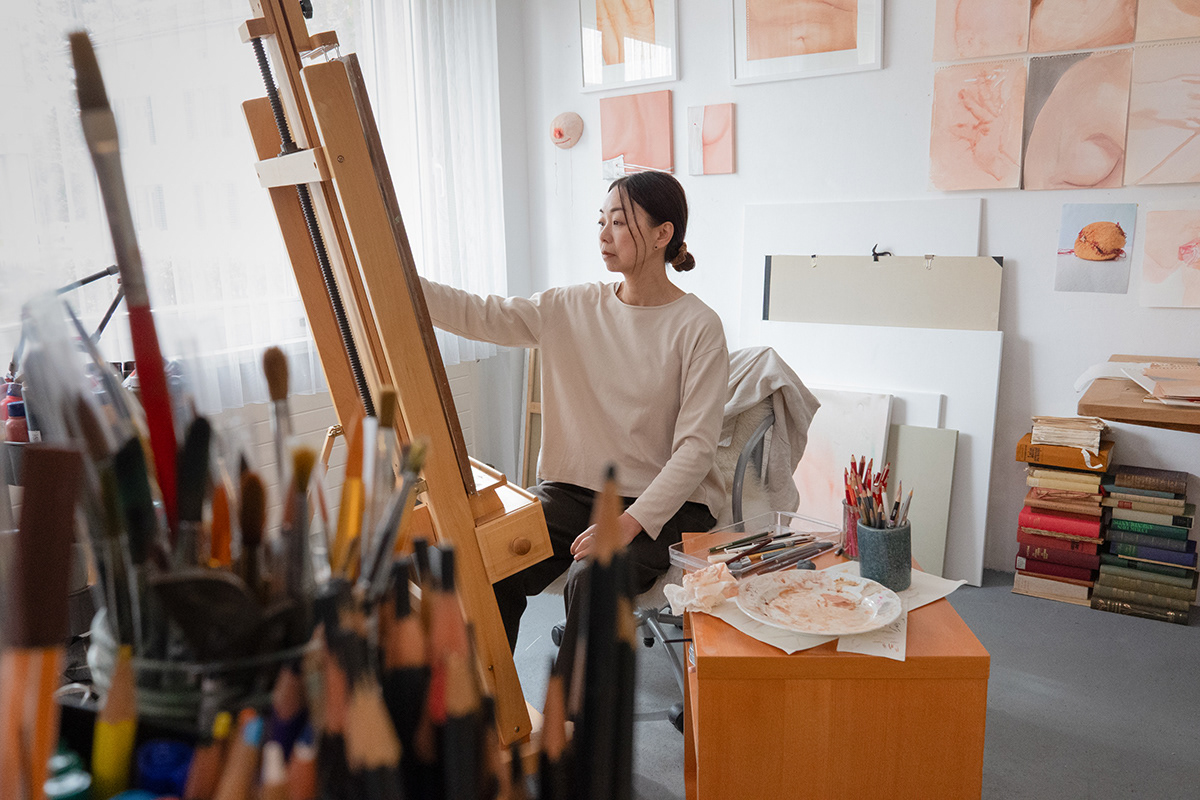
Xu Ying, born in Shanghai, lives and works in Feuerthalen, SWITZERLAND.
Her practice centers on the resonance between body and consciousness, exploring the subtle relationships among personal experience, cultural memory, and the passage of time. Painting remains the foundation of her work—a way of perceiving, reflecting, and tracing emotion through form. Through depictions of the human body, she examines how social and cultural imprints are inscribed upon the flesh, shaping both identity and perception.
Her practice centers on the resonance between body and consciousness, exploring the subtle relationships among personal experience, cultural memory, and the passage of time. Painting remains the foundation of her work—a way of perceiving, reflecting, and tracing emotion through form. Through depictions of the human body, she examines how social and cultural imprints are inscribed upon the flesh, shaping both identity and perception.
IMATELIER: Ying, your studio feels warm, inhabited, almost like an extension of your artistic practice. How significant is this space for you?
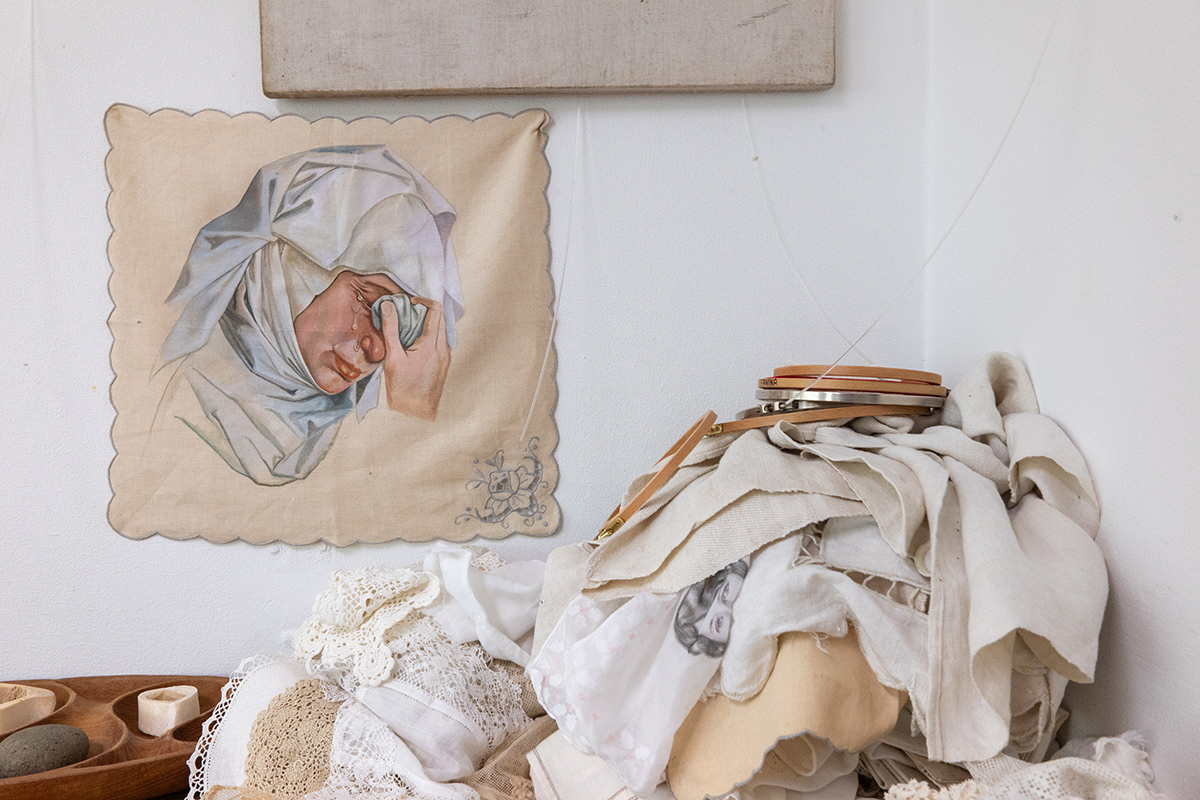
YING: Thank you, I’m touched you felt that warmth. My studio is part of my home, and it holds my everyday rhythms: the quiet mornings, the traces of cooking, the late hours when the house sleeps and thoughts open. In Switzerland, having your own space is not something you can take for granted. It’s expensive, and it’s not always easy to find. So this studio is precious to me... not as a luxury, but as a kind of inner shelter.
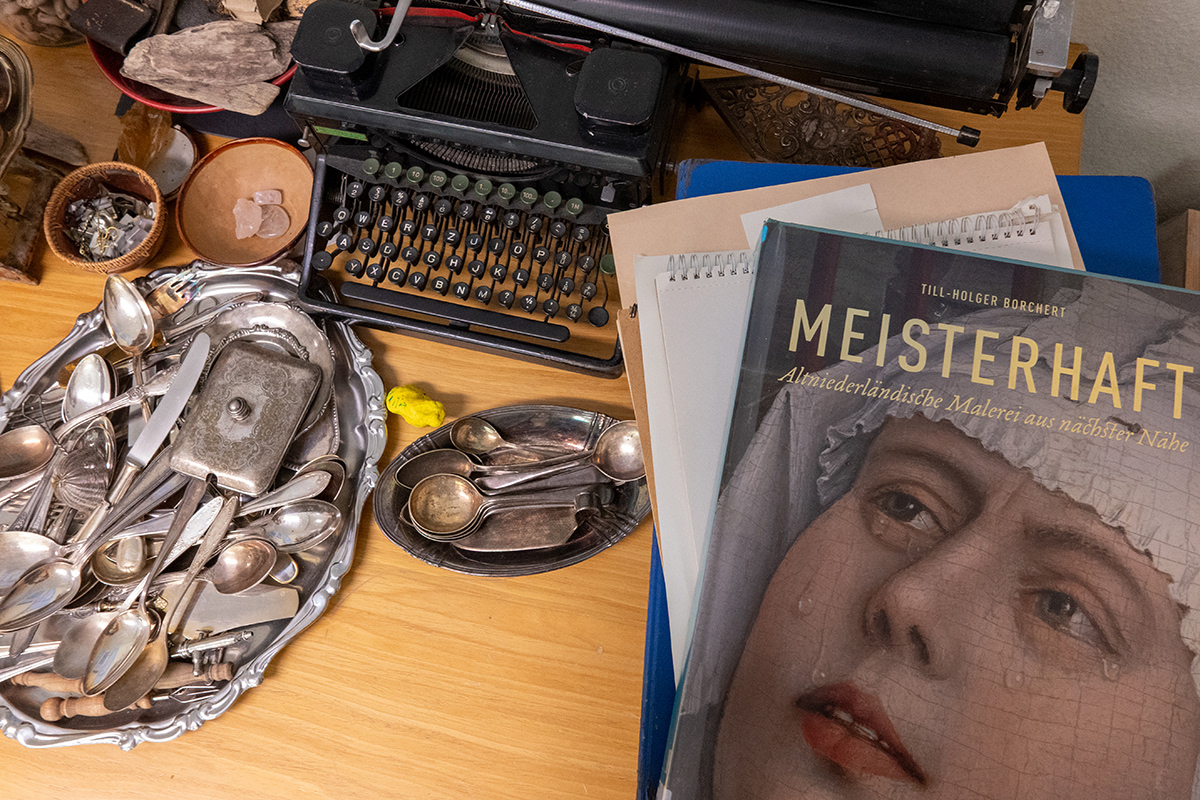
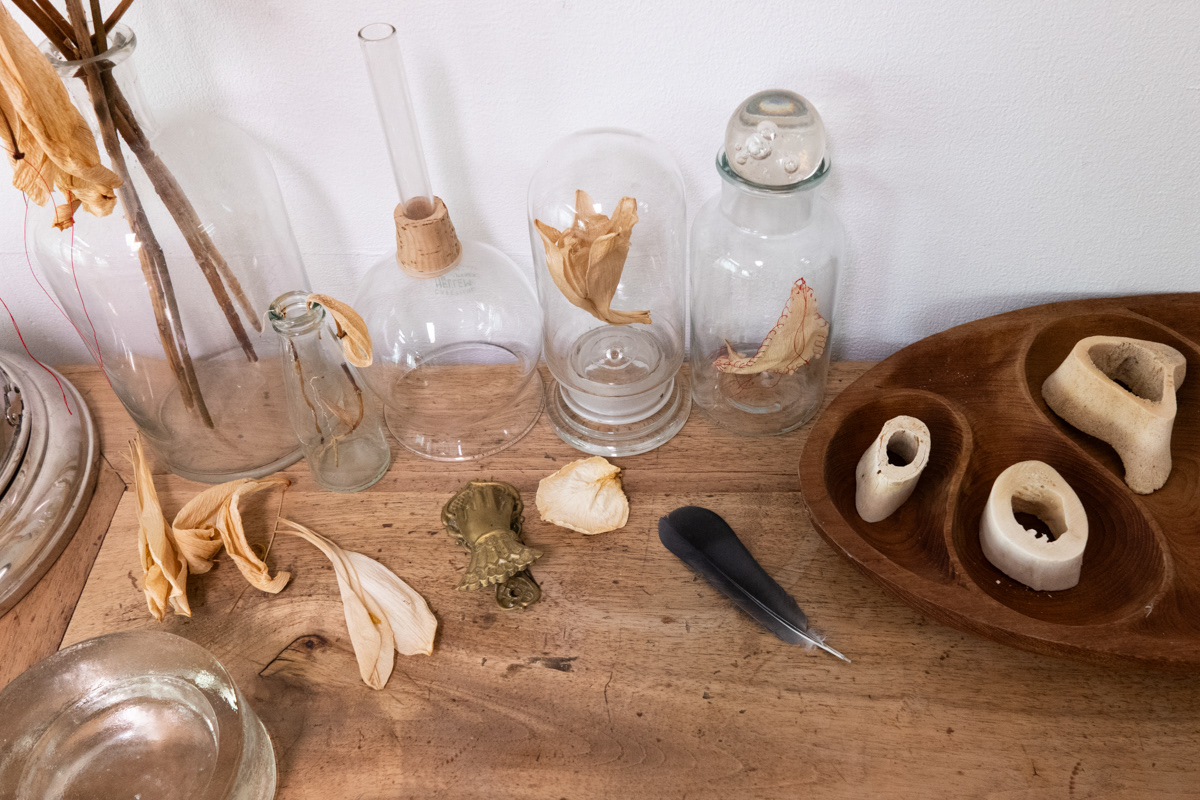
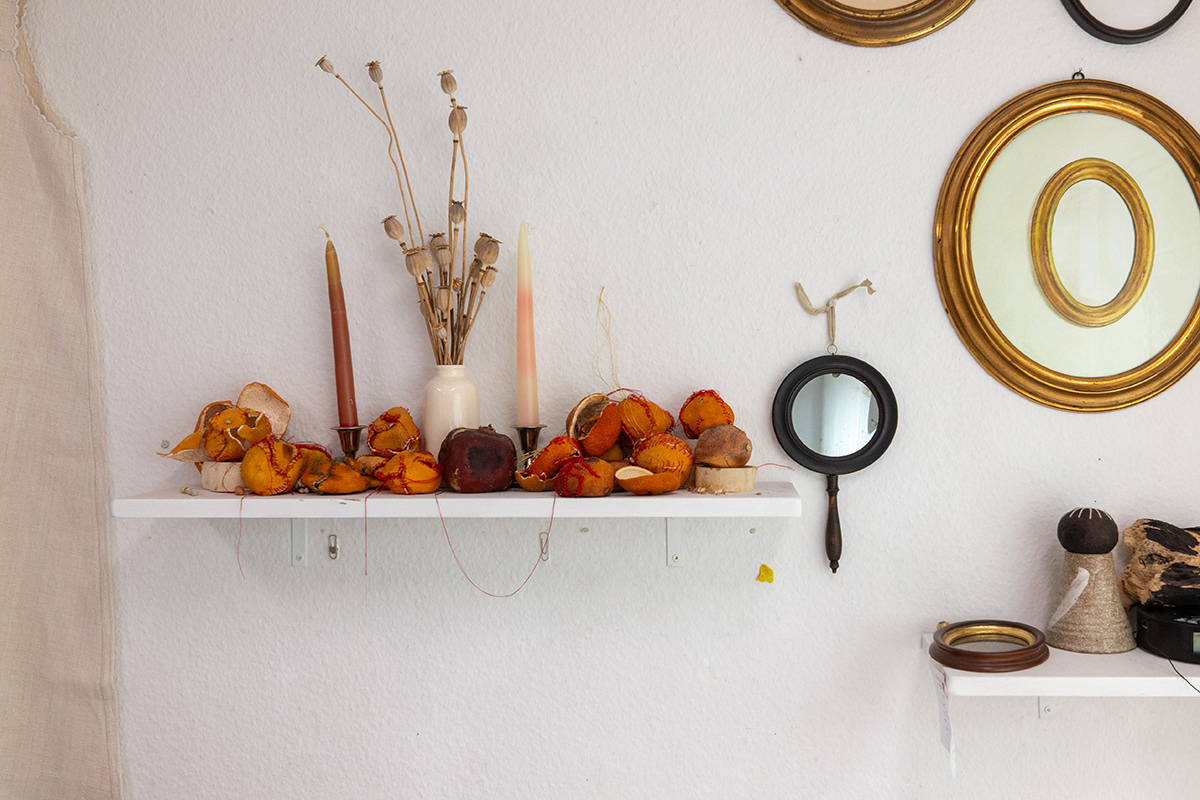
Objects gather here over time. A dried plant from a walk. A stone carried back from a trip. Fabrics, old books, fragments, pages with marks. They stay with me and some eventually enter my work; others remain simply as companions. The room fills with them, can be messy but they soften the space, they make it feel inhabited by thought.
IMATELIER: What do you appreciate most about it?
YING: The privacy and independence it gives me, the sense that I can close the door and belong fully to myself. This inseparability between living and working is not abstract; it’s a lived truth. It echoes something I believe deeply: a woman needs a room of her own, a space where her thoughts can breathe without interruption. Virginia Woolf wrote about it, and here I feel it every day. This room allows me to disappear into my thoughts, it holds me, and it lets me be. That intimacy with a space. That freedom is something I truly treasure.
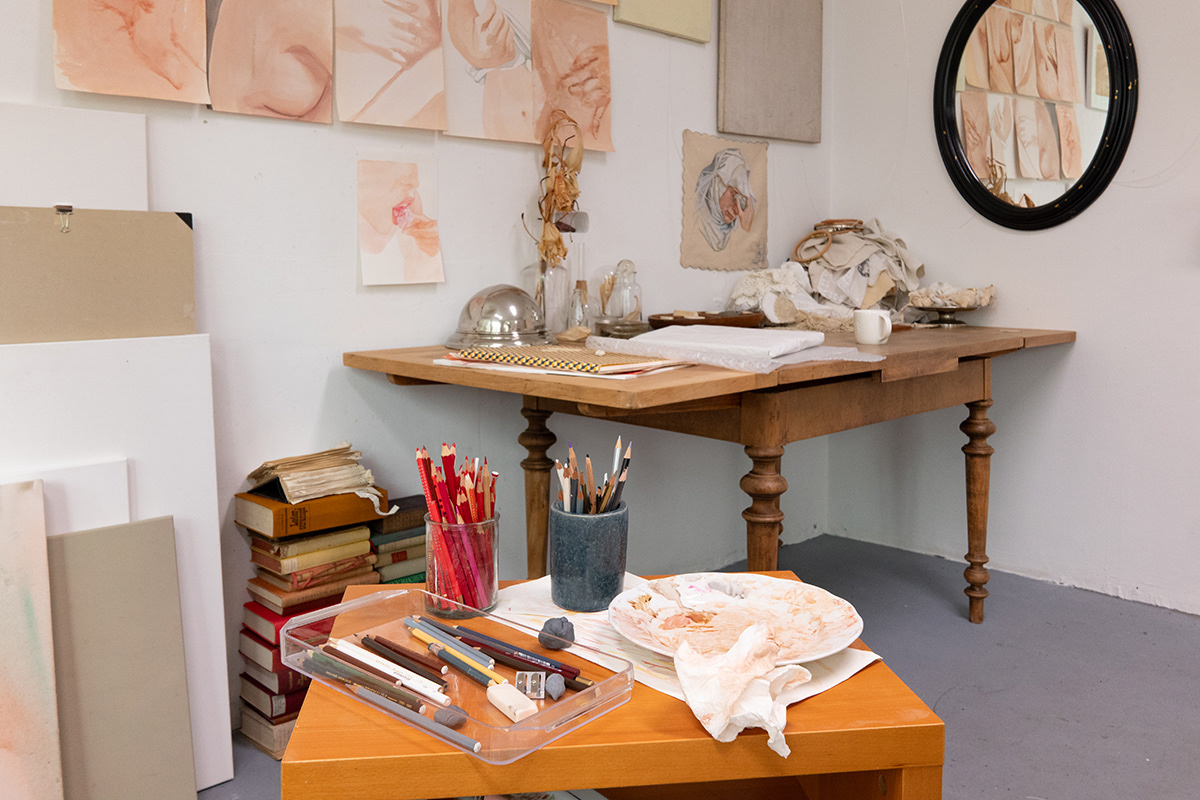
IMATELIER: It really feels like a very private, intimate space! But on the flip side, are there any challenges to having your studio right next to your home? How do you keep a distance between your personal life and your art practice?
YING: You’re right... it is a very intimate space, and that closeness is both a blessing and a challenge. The biggest difficulty is exactly what you mentioned: the boundary between personal life and artistic life becomes very blurred. When your studio is next to your home, everything flows into everything else. The chaos, the quietness, the emotions, the thoughts — they don’t stay neatly separated. But in a way, that’s also who I am. Life and work are intertwined for me. I don’t believe they can ever be completely separated, at least not in my life. Being an artist is also a way of living, a way of perceiving. So yes, the blur is challenging, but it also feels natural, almost inevitable.
If there is a disadvantage, it’s the solitude. Working alone in my own studio means I don’t have the spontaneous conversations or exchanges that happen in shared studios. I don’t easily meet peers in the everyday flow. I have to work things out on my own. The doubts, the ideas, the questions... It demands a lot of inner discipline and self-dialogue.
At the same time, having the studio attached to my home has been a huge advantage, especially as a mother of two. My life has often been divided into small pieces: moments of care, moments of work, moments of rest. Having the studio so close saves time and energy. I can switch quickly: from preparing a meal to thinking about a work; from taking care of the children to sketching an idea before it disappears. This flexibility has allowed me to continue my practice during years when time was very fragmented.
So yes, there are challenges. But this setup also gives me a rhythm that feels true to my life, a way of working that grows directly out of the reality of being a mother, a woman, and an artist at the same time.
IMATELIER: Since we touched this topic... I'd like to ask how you view your identity as a woman in relation to your work as an artist, and what is your perspective on the term ‘woman artist’?
YING: This is a complex question for me, because being a woman is inseparable from how I live, and therefore also inseparable from how I work. But I don’t wake up thinking, “I am a woman artist.” I wake up simply as myself... with my emotions, my cultural background, my body, my memories. All of that enters the work naturally.
Being a woman definitely shapes the way I perceive the world: my sensitivity to materials, to fragility, to care, to time. It shapes how I navigate expectations and the invisible labor women often carry. These experiences mark my practice, even when the work isn’t explicitly about gender.
At the same time, I have a complicated relationship with the term “woman artist.” On one hand, I understand its importance: historically, women were excluded, overlooked, or made invisible in the art world. The label can be a way to acknowledge those inequalities. But on the other hand, the term can feel limiting, as if the work is defined by a category before it’s seen for its own merit. I want the work to breathe in its own way, without being reduced to a simplified identity. So while I am a woman and an artist, I prefer to let the complexity speak through the work itself.
IMATELIER: ... And your work speaks for itself. It encompasses layers and conveys a sense of openness and vulnerability that I find very captivating. Could you tell us more about your practice, please?
YING: I’m always curious how people read my work, because every interpretation opens a different entry into the practice. For me, the work has grown out of a long process of becoming, really an attempt to stay close to certain sensations that are very strong for me, but hard to put into words.
I work with materials slowly, through repeated gestures and accumulations. It often feels like a conversation: sometimes I construct an image, and sometimes I follow what the material is telling me. Even though the works often end up being figurative, the process itself is very much about perception. I’m less interested in representing the body than in tracing how the body feels. How tiny, almost invisible sensations leave their imprint. There’s a kind of core feeling I’m always trying to approach: something abstract, fleeting, almost pre-verbal. Some days I feel close to it, and other days it disappears completely. That movement, that instability, is very much part of the practice.
So my work is both technical and intuitive. It depends on repetition, on the physicality of drawing, and on sensing what a surface can or cannot hold. At the same time, it’s guided by an embodied intuition — a way of perceiving shaped by lived experience and distinctly feminine sensitivity.
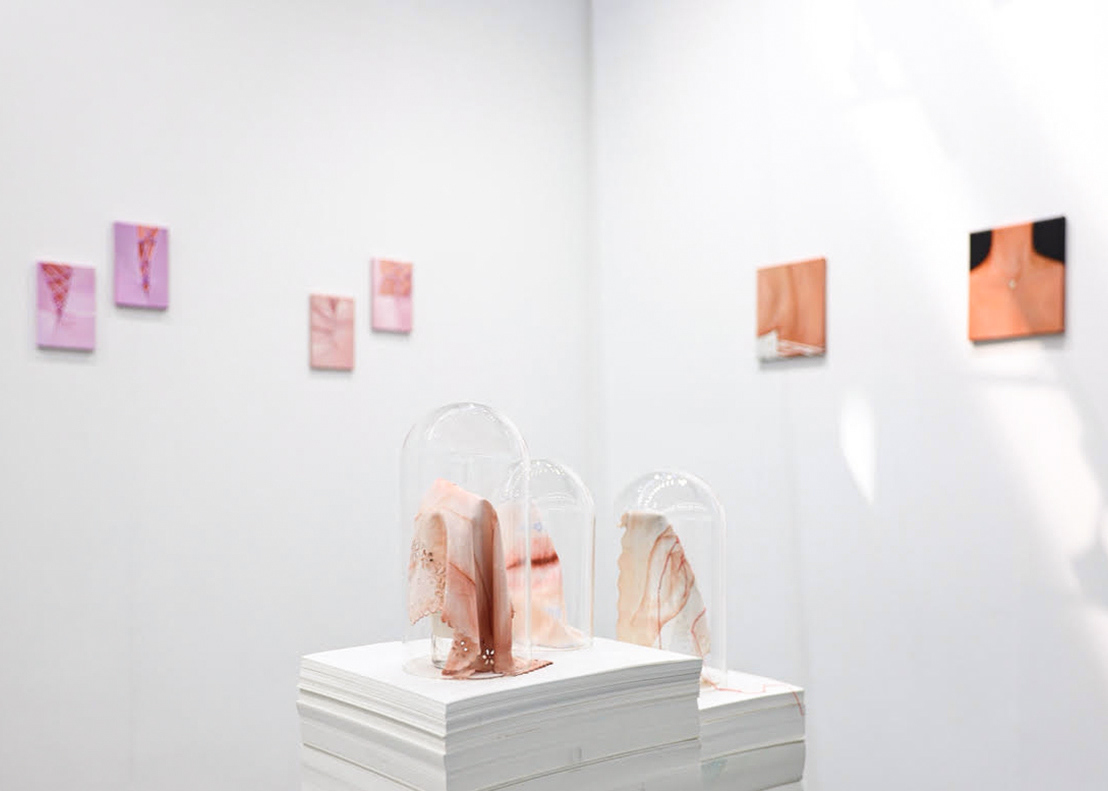
Velvet Edge, Exhibition View, Shenzhen, 2025
© Swallow Gallery
IMATELIER: Your process, as you describe it, is very intimate and personal. How about your performative works? Sometimes you invite others to participate. For example, in your Mending As A Manner series?
YING: That’s a beautiful question, because my performative works, especially Mending as a Manner, come from the same intimate place as my studio practice... but they open into a very different dimension. The mending performances actually began as something very private: a quiet gesture of repair using my hands, thread, and an everyday object. Over time I realised this gesture didn’t belong only to me. It carries something universal, something people immediately understand through their own bodies.
When the work expanded into participatory formats, I became interested in how a simple act of repair could function as a shared methodology. The workshops and performances are not about spectacle, but about creating a space where attention, slowness, and embodied knowledge can be practiced collectively. In that sense, the piece operates on both an individual and a structural level: it links the intimate, domestic gesture of mending with broader questions of care, vulnerability, and how we hold things (and each other) together.
What emerges in these settings is not only community, but also a form of distributed authorship. The gesture circulates across different hands and ages, dissolving the boundary between artist and participant. For me, this shift is important: it shows how a personal gesture can become a conceptual framework, and how a quiet, almost humble action can open up a larger conversation about repair as an aesthetic, ethical, and social practice.
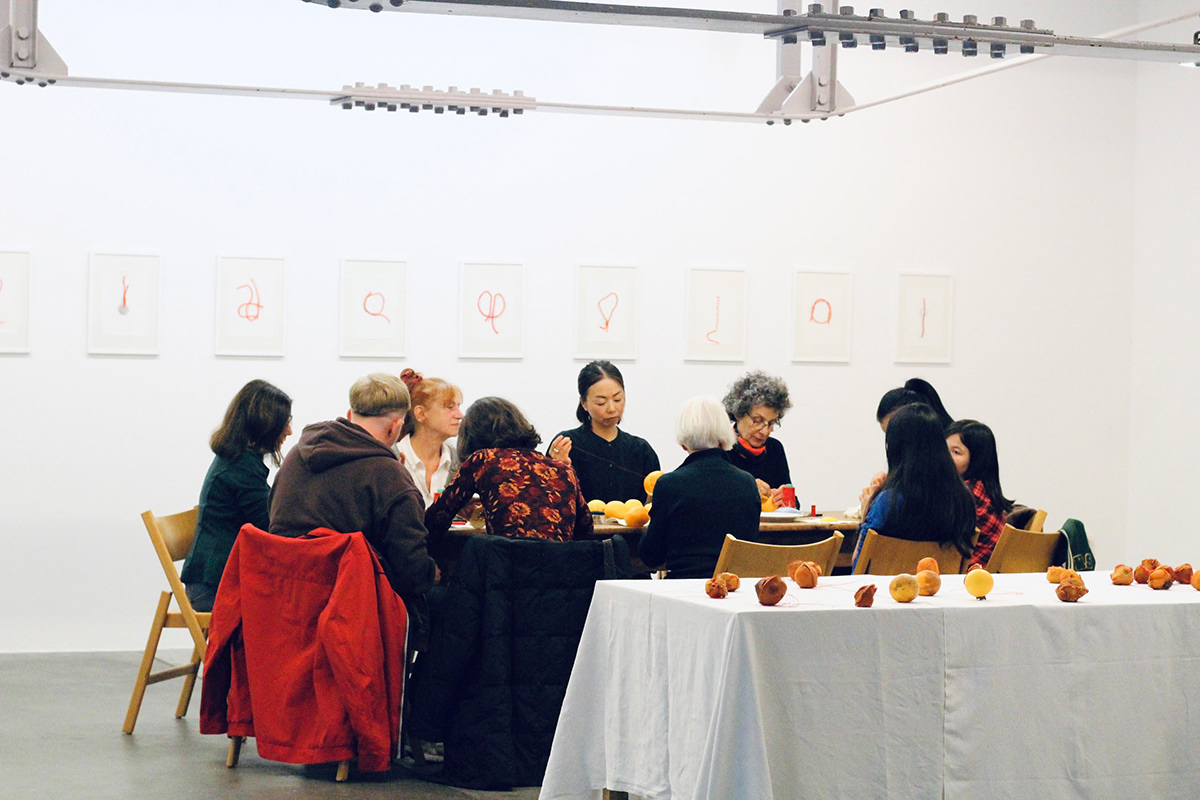
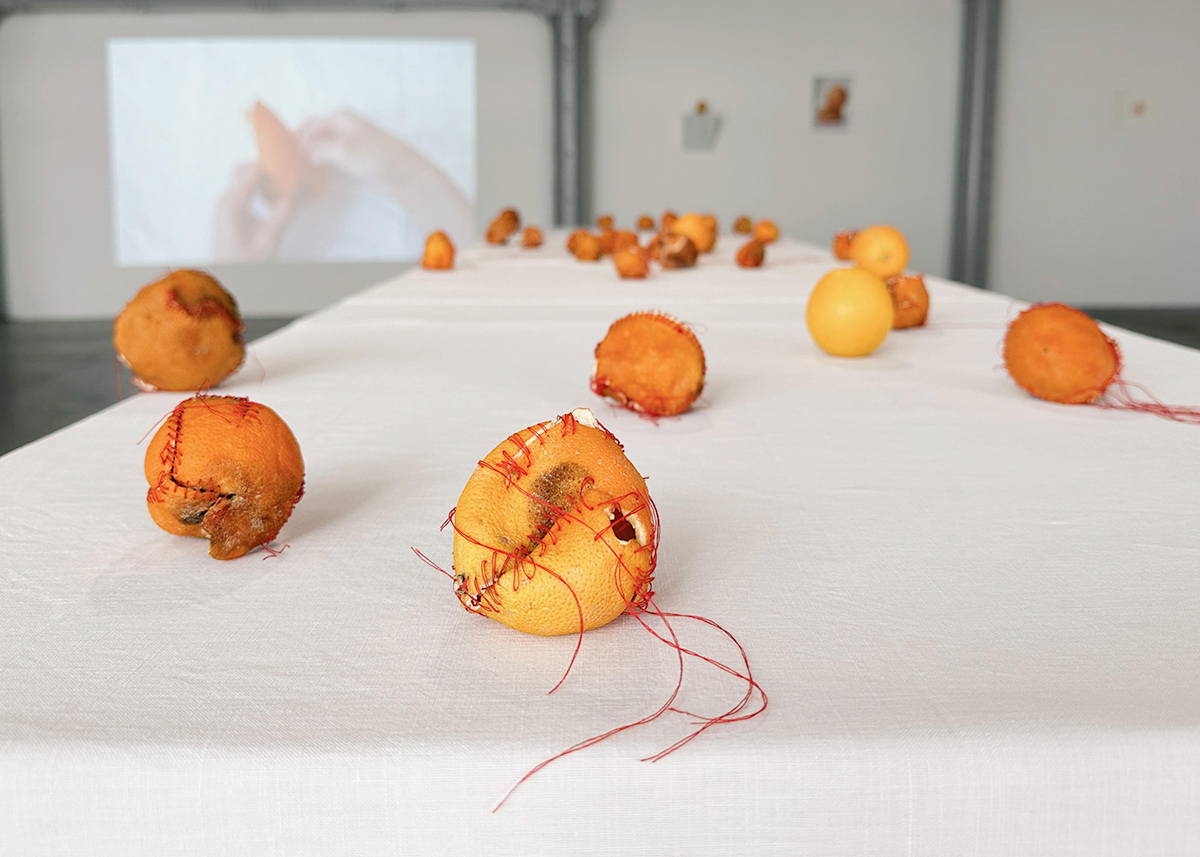
Mending as a Manner, Vebikus Kunsthalle, Schaffhausen, 2023
Photo courtesy of the artist.
IMATELIER: Ying, thank you for these insights! Before we close, let’s end on a dreamy note: If three wishes for your art career could suddenly come true, what would you ask for?
YING: It’s a difficult question! If I imagine the future without restraint:
Wish one: That my work travels widely — to museums, galleries and places not only for visibility, but because these contexts allow the work to be read in deeper, long-term ways.
Wish two: That I can collaborate with brilliant minds across disciplines, form constellation of ideas around the work. With curators, writers, philosophers, performers. People like Chus Martínez, Samuel Leuenberger, Hans Ulrich Obrist, Judith Butler...
Wish three: I hope for large-scale studio possibilities and to build a long-lasting artistic legacy: a body of work that continues to grow, evolve, and communicate beyond me. Something that contributes to the broader discourse on embodiment, care.
12/12/2025